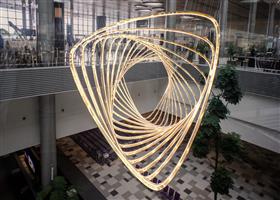



《拉斐尔的钟摆(Raphael's Pendulum)》是一项2018年在德国罗氏Penzberg Pharma和诊断中心的新建筑中展示的现场特定装置。这个动态艺术作品悬挂在自然采光的中庭,作为一个集中互动和交流的空间,连接着办公室、会议室和实验室。
《拉斐尔的钟摆(Raphael's Pendulum)》探讨了对知识的推进,同时也提到了过去的开拓性成就。这个艺术装置的起点是拉斐尔的著名作品《雅典学派》,这是文艺复兴时期最著名的绘画之一。这幅作品全面地展现了对知识的获得。在这幅历史画作的中心,我们看到柏拉图和亚里士多德,他们为人文学科、自然科学、伦理学和政治学奠定了基础。其他哲学家、数学家、医生和天文学家从古代到文艺复兴时期都在他们旁边被描绘出来。这幅画展示了获得知识的可能途径:思考、写作、绘画、阅读、讨论、倾听、教学和学习。
在一个动态的编排中,一根摆锤穿越虚拟的画作,在整个中庭无形地展开,使其逐块可见。摆锤的第一次摆动移动到画作右侧的拉斐尔自画像处。然后,在另一次摆动后,屏幕停留在不同的人物身上。摆锤摆动的序列和突出显示的人物与他们与拉斐尔最相似的面部相对应。摆锤聚焦于58位人物中的21位,并在几乎整幅画作上摆动。
这根摆锤穿越了一个高度为18米、四层楼高、宽度几乎为13米的平面。文艺复兴时期所描绘的理想建筑与建筑物现代清晰的结构展开对话。
RAPHAEL’S PENDULUM, 2018
Roche Penzberg, Germany
The site-specific installation transports the beginnings of European intellectual and scientific history to a place in which forward-thinking research and knowledge transfer—a new building at the Pharma and Diagnostics Centre Roche Penzberg. The kinetic artwork is suspended in the naturally lit atrium, that serves as a central space for interaction and communication and links offices, meeting rooms and laboratories.
Raphael’s Pendulum addresses the advancement of understanding while simultaneously referring to pioneering achievements of the past. The starting point for the art installation is the “School of Athens“, one of the most famous paintings by Raphael and of the high renaissance. It is a holistic picture about gaining understanding. In the center of the historic painting we see Platon and Aristoteles who laid the foundations for humanities, natural sciences, ethics and politics. Further philosophers, mathematicians, physicians and astronomers from the ancient to the Renaissance period are portrayed next to them. The painting shows the possibilities of gaining knowledge: thinking, writing, painting, reading, discussing, listening, teaching and learning.
In a kinetic choreography, a pendulum swings across the virtual painting, which is stretched invisibly across the atrium, making it visible piece by piece. The first swing of the pendulum moves to Raphael’s self-portrait at the right side of the picture. Then, after a another swing, the screen pauses at a different figure. The sequence of the pendulum swings and the figures highlighted correlate to their greatest facial similarity to Raphael. The pendulum focusses on 21 personalities of the 58 people portrayed and swings over nearly the whole picture.
The pendulum moves across a plane that spans a height of 18 meters, four building floors and a width of almost 13 meters. The depicted, ideal architecture of the Renaissance and the contemporary, clear architecture of the building enter into a dialogue.